For retail chains with 10+ stores

Fractional COO for Retail Chains

A chain should not take seven days a week from its owner.

I take over daily retail operations: KPIs, the team, product and key projects. You get a strong operations director, and with that the time and room to run the business again instead of putting out fires nonstop.

Your job is to run the business again, not to live inside it.

In my current project the chain grew from 32 to 37 stores. In three months net profit rose 53%, and the margin was about 51%.

Tell me what you want to solve in your chain. In 20 minutes we will go over the situation and see how I can help.

Marat Gafurov

The chain grew. Management did not keep up.

With five stores you can hold a lot in your head. With 10, 20 or 30 locations the same model starts to fail.

Decisions still flow back to the owner. Managers can execute, but they do not always find the problem, make the decision and answer for the result on their own.

When a chain depends too much on its owner

  • Fast-moving items run out while more and more money sits in stock.
  • One store has an empty shelf while another has the same item sitting as dead stock.
  • Store managers bring problems, but everyone still waits for you to decide.
  • To understand why a store dropped, you have to collect the numbers yourself, call people and dig for the cause.
  • If you step away from operations for a few days, some questions simply wait for you to come back.
  • Without you, many questions simply do not move.
  • A new store brings not only revenue but also one more stream of tasks, calls and manual control.

If this sounds like your business, the problem is not that you control too little. On the contrary, the chain depends on you too much.

My job is to make it run on a system, on numbers and on strong managers.

Below is my current project: what changed in management and how the numbers moved.

What happened in the current project

Scale32 → 37

stores in the current chain

Net profit+53%

over three months

Margin≈51%

over the current period

The chain broke its revenue record twice. In the first 20 days of August, revenue was 13.7% higher than in the same days of July. Since the project started it has grown by a third.

The growth did not come from a single setting or a single promotion. We built the area manager function from scratch and rebuilt daily chain management and logistics: warehouse work, order and delivery schedules, the work of logistics staff and transfers between stores. In parallel we set up KPIs for sales staff, store controls and project management. We built a management dashboard where the chain's key numbers are visible online.

Below I show how exactly this system works.

You can start with one specific problem

If we have not worked together before, you do not have to hand me the whole chain at once.

More often it makes sense to start with a limited area of the business and check the result in numbers.

If the problem is ordering and stock, we will check:

  • who makes the ordering decision and how;
  • how availability of fast-moving items is controlled;
  • how the chain sees excess and slow-moving stock;
  • how transfers between stores work;
  • who is accountable for the final result.

If your challenge is different, we start with that. On the first call we will decide which data to check and where it makes sense to begin.

If we see a clear growth point, I will propose a limited project with a defined scope, timeline and before-and-after metrics.

What I take on

I do not arrive with a report and a list of recommendations. I join your existing team, change processes and take responsibility for making the new rules actually work.

Finance and business metrics

P&L, revenue, gross and net profit, plan vs. actual, operational and commercial reports. You see in one place what is happening in the business and exactly where a deviation appears.

Product and logistics

Assortment, ordering, stock, OOS, warehouse, order and delivery schedules, logistics staff and transfers between stores.

Stores

Plans, metrics, deviations, standards, inspections, causes of failures and tasks for every store.

Managers and team

Areas of responsibility, KPIs, regular management routines, hiring, development and replacing people who do not perform.

Growth

New stores, new formats, local marketing, automation and growth projects.

What this looks like in practice

Every week, store data turns into specific decisions: a manager checks the cause, proposes an action and owns its execution.

Chain summary

Sales, margin, plan, trends and deviations by store are visible in one place.

  1. What we look at

    Revenue, transaction count, average ticket and gross income for the chain, clusters and each store.

  2. What we compare against

    The plan and comparable days. Changes in working hours or incomplete data are flagged separately.

  3. What needs attention

    A metric drop, a shortage of fast-moving items, or a store with an unexplained deviation.

  4. What happens next

    A manager is assigned to the question. They check the data and bring a conclusion or a plan for further checks.

For every significant deviation, the area manager gives a comment and an action plan.

What should change in three months

Managers see deviations themselves, work out the causes, propose a solution and answer for the result.

The owner no longer has to personally start every management cycle.

That is exactly what reports, KPIs, inspections and meetings are for. Dashboards alone create no value.

The main result: the owner stops being the only source of management decisions in the company.

To answer for results, I need authority

We define areas of responsibility up front. Otherwise I am accountable for a metric while decisions are made in several places at once.

What has to be agreed:

  1. hiring and replacing staff within my scope;
  2. access to the accounting system and operating data;
  3. the ability to change processes, roles and job descriptions;
  4. an agreed budget for the necessary changes;
  5. a single way of assigning tasks to the team;
  6. written records of key decisions and responsibilities.

This does not mean the owner loses control.

Large expenses and fundamental decisions are agreed in advance. Once a week we review results and key actions. Employees simply should not have two parallel managers.

Detailed case

Current project: a retail chain. At the start there were 32 stores, now there are 37.

What was in focus:

  • managing metrics by store;
  • building the area manager function from scratch and regular management routines;
  • rebuilding logistics: warehouse, order and delivery schedules, logistics staff and transfers between stores;
  • KPIs and management of sales staff;
  • regular inspections and a management dashboard with the chain's key metrics online;
  • managing projects and the development of the chain.

Result for the current period:

  • The chain broke its revenue record twice. In the first 20 days of August, revenue grew 13.7% over the same days of July;
  • Since the project began, revenue has grown by a third;
  • net profit up 53% over three months;
  • margin of about 51%.

Important: I do not attribute all the growth to one factor. The result is shaped at the same time by changes in management, product, people and the underlying dynamics of the business itself.

Net profit of the chain by month Index, June 2026 = 100
Net profit of the chain by month, index June 100, July 124, August 153. Growth three months in a row, a total of plus 53 percent versus June. 100 124 153 JUNE JULY AUGUST

The figures come from the chain's accounting system. I show the trend without absolute amounts so as not to disclose the client's financial data.

+53% Net profit growth

June to August. Three months in a row, each higher than the previous one.

13.7% Revenue growth

First 20 days of August versus the same days of July.

≈51% Margin

Held at the level of the start of the project.

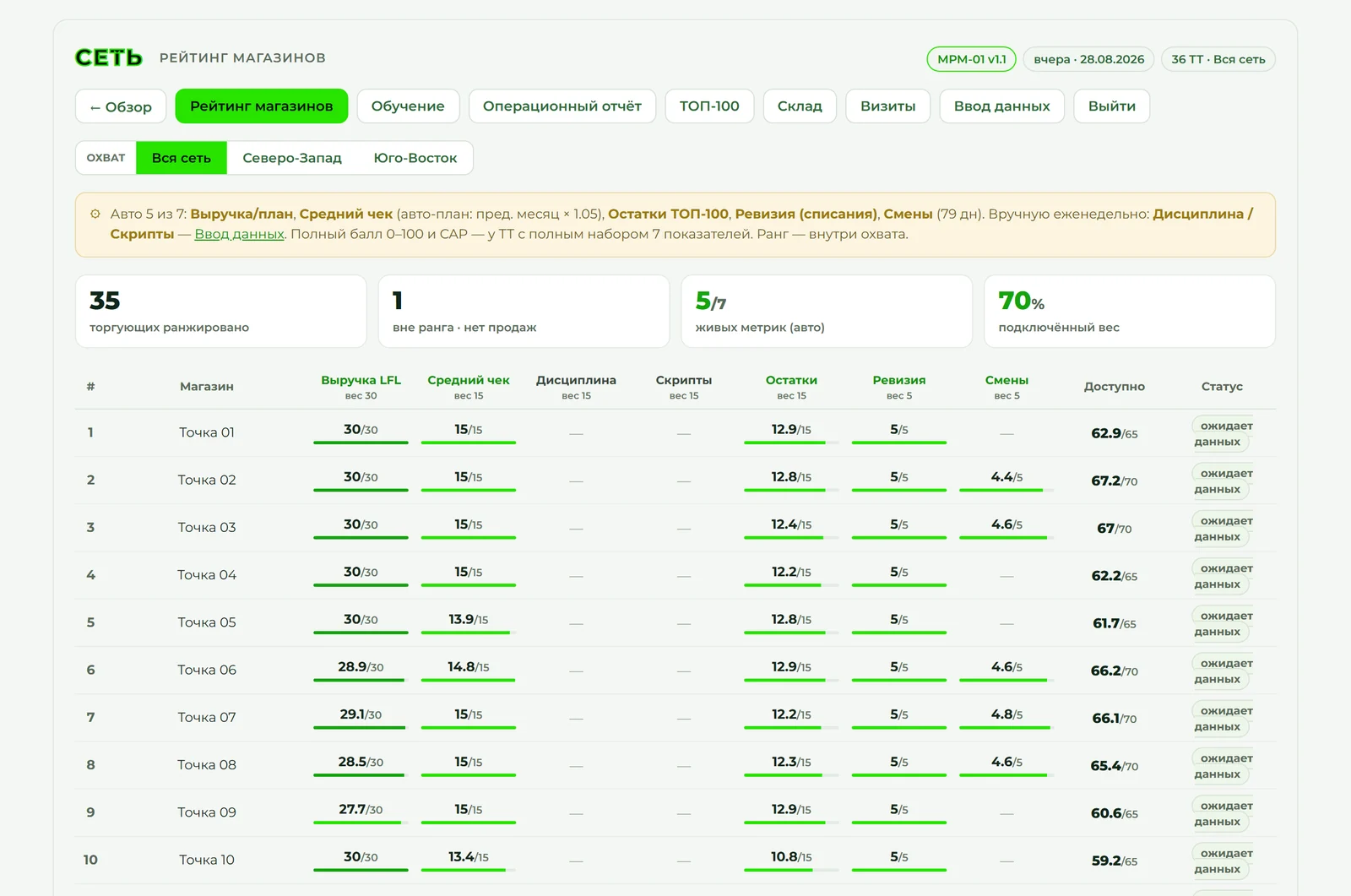
Store ranking working screen (Russian-language interface): stores are ranked by seven weighted metrics, with scores and completion bars on each row
Store ranking in the current chain. Screenshot dated 28 August 2026, when the ranking listed 35 stores; the chain now has 37. The interface is in Russian.

14 years in retail. The experience I bring to your chain.

  • Lenta+52% LFL turnover year over year.
  • PerekrestokThe store ranked first in Russia by gross income among stores of its format.
  • BillaTurned a loss-making store into a top-10 store in the chain.
  • Lyubava, 10 storesCluster turnover grew 35% and losses fell 30%. Four loss-making stores turned EBITDA-positive.
  • Tasty, 13 stores+31% in retail turnover and moving the chain to a fully legal operating model.
  • Current chain, 37 stores+53% net profit in three months. The chain grew from 32 to 37 stores and broke its revenue record twice.

Who it fits

Most likely we are a good fit if:

you have 10 or more stores;

you have data in an accounting system;

you want to step out of daily operations, not just get another report;

you are ready to change processes and people's responsibilities;

you are ready to give the manager real authority.

Most likely I am not a fit if:

you have fewer than 10 stores;

you need a manager who is physically in the stores all the time;

there is no access to real operating and financial data;

existing processes and roles cannot be changed;

you want analytics only, with no changes to how the team works.

How we work

First I get to grips with the numbers and how the chain is built. Then, together with managers, I change processes and check the result every week.

01 / Joining the project

The first two weeks

This stage is part of the first month of work. I set up reporting and the history of metrics, review how the key areas work and, together with the owner, set goals for the quarter.

You get a roadmap: what we change, in what order and what financial effect we expect.

02 / Regular work

Every week

With the area managers and the category manager I go through deviations and decisions. Every task has an owner, a deadline and a check of the result.

Separately with the owner we review key actions and record agreements in writing.

A team for the task

When needed I bring in HR specialists, a category manager and developers. Their roles, tasks and pay are agreed separately before they join.

The first contract for running the chain is for three months. If we start with one specific problem, the scope and duration of the project are discussed separately. I run no more than three chains at a time and do not work with direct competitors in the same region.

FAQ

Can you tell me in advance how much profit will grow?
No. Without data that would be an invented number. After the initial deep dive we set the baseline, target metrics and how they are measured.
How do you run a chain remotely?
Through data, regular management routines and clear accountability inside the team. I see sales, stock, store metrics, tasks and deviations. When a physical presence is needed, a local employee or a pre-agreed specialist goes.
What will happen to my current managers?
In most cases they stay. I do not arrive to replace the existing team automatically. First I work out who is responsible for what, who really carries their role and where the gap is.
Do I need to hand you all operations right away?
No. If we have not worked together yet, you can start with a limited problem and judge my work on a specific result.
What happens on the first call?

In 20 minutes we will discuss your challenge, the current situation and the result you want to achieve.

We will decide which data are worth checking and where it makes sense to begin.

How work begins

  1. Step 1. Review, 20 minutes

    We discuss your challenge and how the chain is organized.

  2. Step 2. Choosing the format of the start

    Either a limited project on a specific problem, or broader work right away.

  3. Step 3. Fixing the scope and the result

    What we change, what we measure, who is responsible for what.

  4. Step 4. Starting the work

    After payment and access to the necessary data.

Discuss your chain

The first conversation takes 20 minutes.

Tell me what matters most to change in your chain right now. After your request I will contact you and agree on a time to talk.

Discuss your chain

Leave a contact and briefly describe your challenge, if convenient. I will get in touch to agree on a time to talk.